Just Burn It

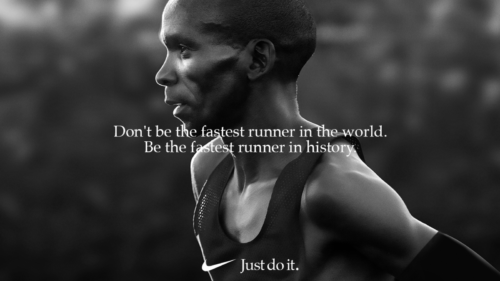
“Believe in something. Even if it means sacrificing everything” is the bold statement stamped across Colin Kaepernick’s commanding face in Nike’s 30th anniversary “Just Do It” ad campaign. Kaepernick took to Twitter on Sept. 3 and revealed his partnership with Nike, creating an uproar on social media.

Why are some people so angry that Colin Kaepernick is the new face of Nike?

In Aug. 2016, Kaepernick began protesting police brutality and racial injustice by sitting during the National anthem. Kaepernick used his platform as a professional football player to advocate for communities and people who don’t have a voice. Police brutality and racial injustice have been underlying issues for people of color in the United States and with the growth of social media, it has brought more awareness to the general public.

“Police brutality in relations of black communities has always been there,” Joy Alino, junior international business major said. “However, now because we have social media, because we have cameras, because it is very quick to have the conversation towards this topic, now it’s in the forefront.”

“I’ll continue to sit. . . I’m going to continue to stand with the people that are being oppressed,” Kaepernick said in a statement to the NFL Media in Aug. of 2016. “To me, this is something that has to change. When there’s significant change and I feel like that flag represents what it’s supposed to represent, this country is representing people the way that it’s supposed to, I’ll stand.”

However, people were angry that Kaepernick used his athletic platform to protest and argued that sitting during the national anthem was disrespectful to active military members and veterans. When former U.S. Army veteran and former NFL player, Nate Boyer, reached out to Kaepernick and voiced his concerns with Kaepernick’s movement, Kaepernick set up a meeting with Boyer.

After discussion, the two agreed on a respectful way to honor those who serve and have served in the military.

“We sorta came to a middle ground where he would take a knee alongside his teammate,” Boyer said in an interview with CBS Sports. “Soldiers take a knee in front of a fallen brother’s grave, you know, to show respect. When we’re on a patrol, you know, and we go into a security halt, we take a knee, and we pull security.”

At the end of the 2016 season, Kaepernick became a free agent and parted ways with the San Francisco 49ers. As he was looking for a team to sign him, he began a campaign called “Know Your Rights Camp,” which was intended to “raise awareness on higher education, self-empowerment and instruction to properly interact with law enforcement in various scenarios,” according to Kaepernick’s website, http://www.kaepernick7.com/know-your-rights-camp/.

He also started a “Million Dollar Pledge” where he donated one million dollars plus all the proceeds from the sales of his jerseys to organizations that work in oppressed communities. He enlisted celebrities and athletes like Alicia Keys, Jesse Williams, Steph Curry, Snoop Dogg, Kevin Durant and Serena Williams to contribute to organizations like “Mothers Against Police Brutality” and “Communities United For Police Reform.”

In addition to this, Kaepernick donated around sixty thousand dollars worth of backpacks to students in Harlem and South Bronx. He also donated to the Black Youth Project 100, an organization with chapters all over the United States, whose goal is to create justice and freedom for all African Americans. Kaepernick additionally traveled around the United States as a keynote speaker addressing topics such as police brutality, discrimination and injustice towards black people.

“I’ve been looking at this for a while, trying to analyze exactly what his message and intentions were because I wasn’t really sure,” Warren Webb, senior computer information systems major, said. “But after reading a few articles, I realized he was trying to stand up for people that really couldn’t stand up for themselves,” Webb commented. “In terms of Nike partnering with him, even though Nike’s intentions may not necessarily be clear, they did elevate his platform.”

In spite of Kaepernick’s efforts to create dialogue and change, the NFL continued to view players kneeling as disrespectful and saw ratings, viewership and overall support declining. NFL commissioner, Roger Goodell, responded to fans by announcing the unanimous decision by the league’s owners to fine any player that kneels during the anthem. Players who do not wish to take part in standing for the anthem must stay off the field until the anthem is performed therefore silencing those who wished to protest.

“My main thing is Colin Kaepernick is protesting against racial injustice, the same way MLK did, the same way Rosa Parks did and other activists did, in a peaceful way but provoking way to get your attention,” Layomi Akinnifesi, senior business management major, said. “Protests are meant to draw attention, so if someone disagrees with him kneeling the question is why? Do they disagree that he’s kneeling against racial injustice? And if it’s not that, chances are they think, ‘it isn’t the time and the place to do it,’ but when is the right time to protest?”

Nike, a huge endorser of the NFL and provider of uniforms and clothing, signed a deal with the NFL last week that they would provide uniforms for all the teams until 2028.

After Kaepernick became the face of Nike, Ian Rapoport, a national insider for the NFL network, tweeted out a statement from the NFL that stated, “‘The National Football League believes in the dialogue, understanding and unity. We embrace the role and responsibility of everyone involved with this game to promote meaningful, positive change in our communities,’ Jocelyn Moore, the NFL’s Executive Vice President of Communications and Public Affairs said. ‘The Social justice issues that Colin and other professional athletes have raised deserve our attention and action.’”

Yet, the NFL is still fining players for kneeling during the anthem.

“For me personally, if you are more upset about the fact that Colin Kaepernick is kneeling down in protest of police brutality than police brutality itself, then you are the issue that needs to be solved,” Alino said.

People took to Twitter to voice their opinions after hearing about Kaepernick becoming the face of Nike. User @sclancy79, tweeted a video of him burning his Nike shoes with the caption, “First the NFL forces me to choose between my favorite sport and my country. Then Nike forces me to choose between my favorite shoes and my country. Since when did the American Flag and the National Anthem become offensive?”

It has become clear in the past two years that people value symbols of freedom more than they actually do freedom itself. These players are exercising their First Amendment right to free speech and protest and are using their platform to fight for basic human rights and equality for all. Instead of understanding what the players are protesting when they take a knee, people are arguing that they are disrespecting America.

“Kaepernick kneeling is one of the most respectful ways to protest,” Akinnifesi commented. “I’m quoting a post I read but, kneeling is a universal sign of reverence and respect, you kneel when you pray, you kneel in front of royalty, you kneel when you propose. Even though protesting is supposed to take you out of your comfort zone, he still is respectful while drawing much needed attention on racial injustice in America.”

In light of all the political turmoil and how the right to free speech is being questioned, it’s important to remember that everyone has the right to protest and speak out on what they believe is true and just. Kaepernick and other athletes protesting the discrimination against people of color and speaking out on issues such as police brutality and racial injustice are using their platform to promote issues that are important in many communities. By becoming the face of Nike, Kaepernick gained a bigger platform to discuss these issue and incite change.

“I want this to be able to show people that yes, America does have its own share of problems, but at the end of the day, America stands for something greater,” Alino said.

Kaepernick ultimately is using his influence and right to free speech to respectfully and peacefully protest prominent issues that affect many communities.

Alino commented on the impact of other athletes’ protests and describes that, at the time, even though they weren’t viewed positively their actions helped create a better world.

“I guarantee you, 50 years from now they’re going to be building statues of Colin Kaepernick and they’re going to be talking about how he helped to lead or at least helped to continue a movement and they’re going to be talking about his actions,” Alino said. “When people are coming out and they are saying these vile things, do you really want the people in your family to look back at you and realize that you were on the wrong side of history?”
Respect is the New R-Word

Everyone knows the harmful impact of being called names. This is especially true for individuals with intellectual and developmental disabilities (IDD). Quinnipiac Best Buddies, however, aims to spread awareness about the harmful impact of the r-word and to end inappropriate use.

Quinnipiac Best Buddies is part of an international organization that pairs individuals who have intellectual and developmental disabilities with college students. Quinnipiac Best Buddies works with a number of host sights or transitional programs around Connecticut. These transitional programs consist of people with IDD who have just graduated high school but are not yet working. The main goal of the program is to teach people with intellectual and developmental disabilities about job skills, community skills and independence. Students who join Quinnipiac Best Buddies have the option of becoming a buddy or an associate member.

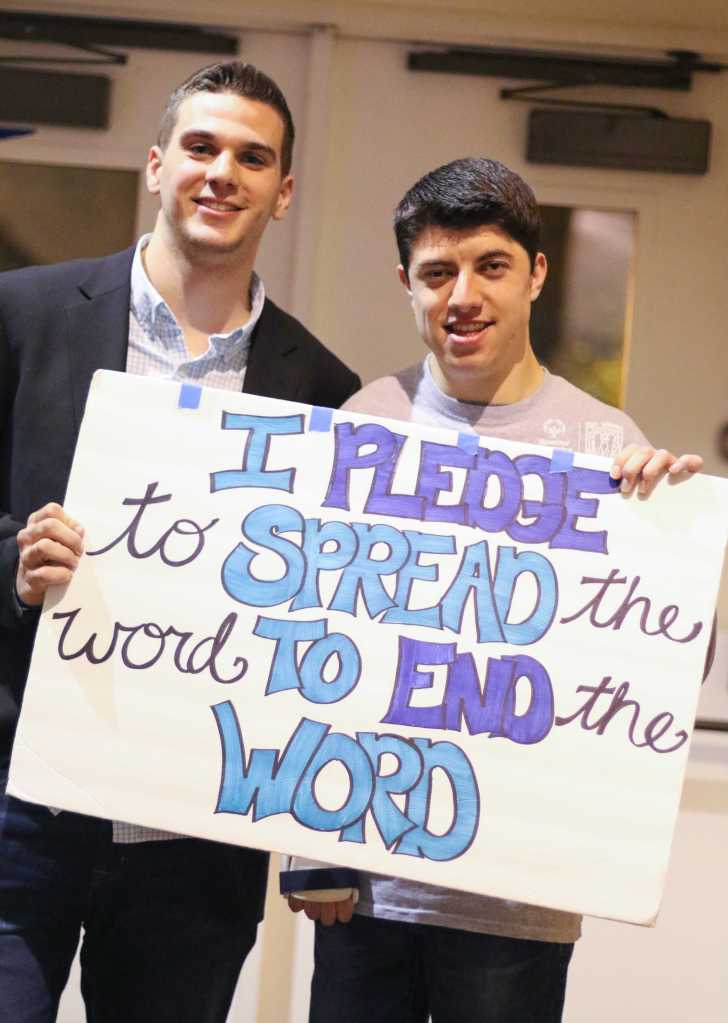
The main goal of “Spread the Word to End the Word” was to bring awareness to the harmful impact of using the r-word in casual conversation. The event was an outlet for individuals with IDD and Quinnipiac students to voice how the word hurts them through creative channels such as singing songs and giving speeches.

Quinnipiac students and their buddies casually strolled into the Mount Carmel Auditorium on Monday night, giving each other hugs and taking pictures with one another. A table was set up at the entrance with free wristbands and a colorful piece of paper, enticing those to enter to sign their names. At each seat there were stickers with the quote “Respect is the new R-word.” The sense of community and inclusion was prominent as the crowd continued to grow larger.

The event started with a poignant video of a girl named Amber with IDD being paired with a buddy named Ali. The video portrayed the importance of the buddies in people’s lives who have IDD. Students and their buddies then approached the podium at the front of the room and told anecdotal stories or showed short videos about the fun times they have shared together and illustrated the impact of their friendship. Some of the activities the buddies do together involve dressing up for Halloween, getting food together, and karaoke.

“We all want to be treated with respect. We want friendship, jobs and to be treated like everyone else,” Angie, one of the buddies, exclaimed in her speech.

A common misperception about people with IDD is that they are unable to perform normal tasks. The buddies at “Spread the Word to End the Word” broke this stereotype. Some own individual businesses and conduct their own radio shows.

The r-word is an outdated medical term that was removed from medical language by former U.S. president, Barack Obama in 2010 when he signed “Rosa’s Law” bill. The bill removed terms such as “mental retardation” and “mentally retarded” from federal health, education and labor policy. New terms that use people first language such as “individual with an intellectual disability” and “intellectual disability” became the appropriate terms to describe an individual.

“We aim at ending the use of the r-word as a starting point toward creating more accepting attitudes and communities for all people. Using the r-word can lead to negative attitudes and actions towards people with disabilities,” Nick Donohue, President of Quinnipiac Best Buddies commented.

Using the r-word equates adjectives such as “dumb” or “stupid” with people with intellectual and developmental disabilities according to senior Vice President of Quinnipiac Best Buddies, Erin Schirra.

“Throughout time, our society has utilized the r-word and incorporated it into our day-to-day language,” Schirra said. “I don’t think a lot of people realize the impact the r-word has on a lot of people in our community.”

These labels that are used to describe people with IDD are politically incorrect and dehumanizing.

“It takes our society a step back,” Schirra said. “We are trying really hard to help people speak in politically correct terms and having inclusive language and inclusive thoughts. We are really making strides in regards to the word and the role of people with IDD and I think that when people use the r-word in day to day language it takes all the steps we’ve taken and it brings it back.”

Quinnipiac Best Buddies fosters these important friendships between students and individuals with IDD and facilitates a relationship that is lifelong.

“Taking someone’s voice away from them is so damaging but once you give someone their voice back, even if they don’t want to talk, but once you give it back to them and they have it, they know that they are heard and that people want them to be there,” Schirra said.

Diversity at a predominantly white university

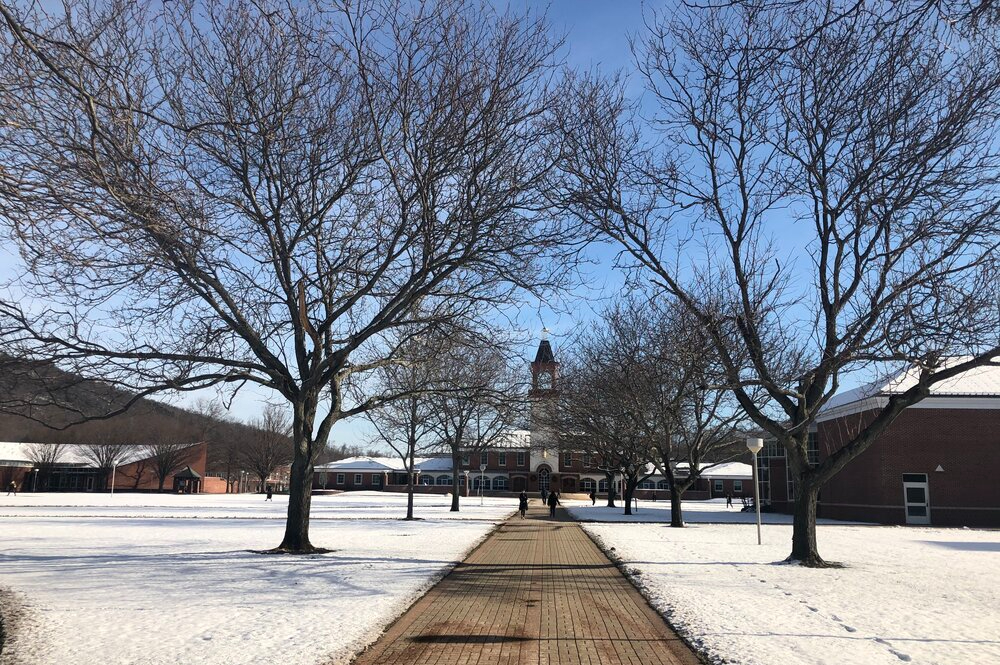
Photo taken by Hannah Tebo

At a university that bears an indigenous name, you would expect a campus celebration for Indigenous People’s Day. At Quinnipiac University, this was not the case. There was nothing on or around campus that acknowledged the day according to Mohegan tribe member and Quinnipiac University student, Kiara Tanta-Quidgeon.

For the small population of indigenous students who attend the university, the lack of Native voices on campus is enough to feel excluded.

“At home, we are all united by our history and our passion for our people,” Tanta-Quidgeon said. “We are all intertwined by not only our ancestry and our blood, but by the love of our land and our culture. This is not something that I have at Quinnipiac, but it is something that I want for current and future indigenous students and will fight for until it is achieved.”

“I always felt that by coming here I was losing a huge part of myself.” — Kiara Tanta-Quidgeon

Tanta-Quidgeon, a sophomore biology major, was raised in Connecticut by a single mother and her indigenous heritage played a huge role in her life. Growing up, she lived near the Mohegan reservation in Montville, Connecticut and would attend the celebrations called powwows and sometimes even danced in them. When she decided on where to go to college, it was a tough decision for her.

“I came here because I wanted to be close to home but I always felt that by coming here I was losing a huge part of myself,” Tanta-Quidgeon said. “I wanted QU to be a place I could call home, but a huge part of what I’ve always known as home was missing. There was a significant lack of inclusion for indigenous students and an absence of indigenous voice in the Quinnipiac community.”

This year, Quinnipiac University was ranked the Princeton Review’s No. 1 university for little race/class interaction.

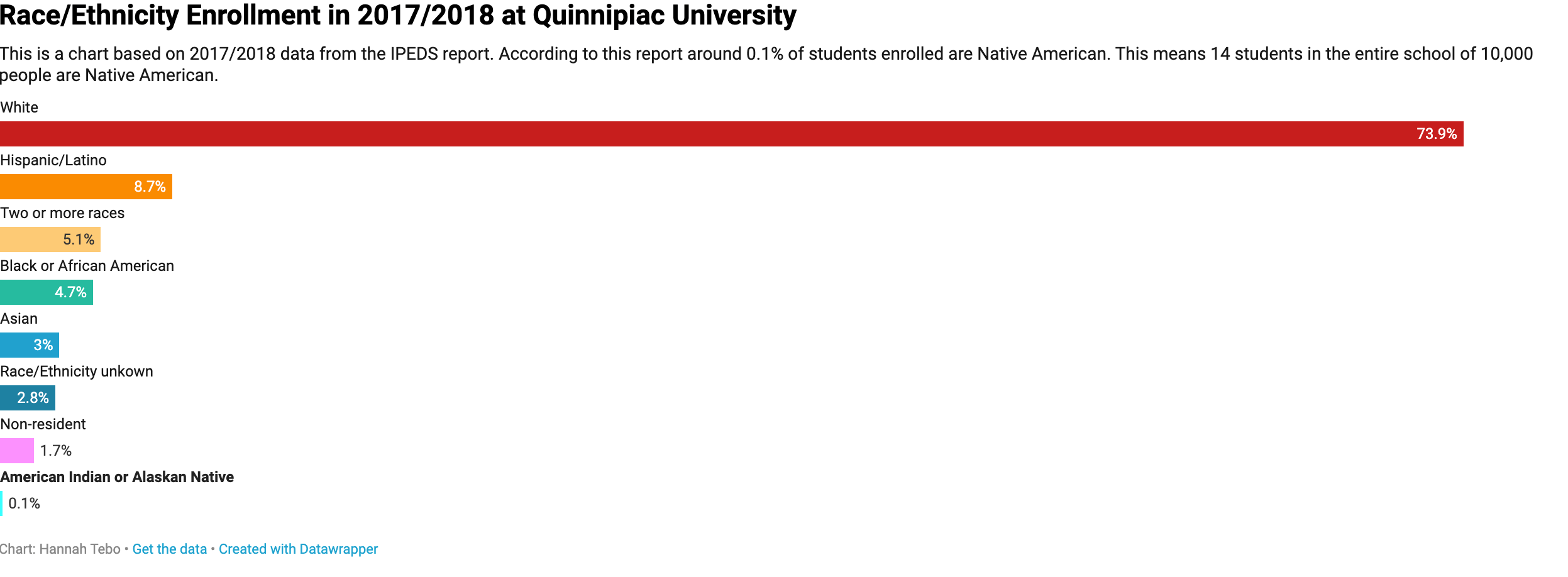
Quinnipiac University, with a 73 percent white student demographic, has a low enrollment of Native American students and other minority groups despite its indigenous name. According to the 2016 IPEDS Data Feedback Report, 0.1 percent of students enrolled in the university identified as Native American.This number translates to 14 Native American students enrolled in a university of about 10,000 students.

The low number of enrolled indigenous students has led students to start questioning the lack of diversity on campus.

“We are predominantly a white, settler-colonists institute that uses a name with little to no credit given to the people and the history of this place,” Tanta-Quidgeon said. “If they didn’t care about the history of their own how were they to care about mine?”

Tanta-Quidgeon explained that a lack of inclusion looks like it does now: an overwhelming majority of the population being Caucasian.

“A lack of inclusion is a lack of diversity and a lack of celebration of differences,” she said. “Our groups and organizations do an amazing job of implementing minority voices in the community and celebrating their cultures and differences, and that is what I want for indigenous students.”

Before this year, Tanta-Quidgeon said she only knew two other indigenous students on campus. And both of them were her cousins. She said that she only met a few more Native students this year so the number is still small.

Despite the low number of indigenous students enrolled, there is no place for these students to gather and celebrate their heritage.

 “There is no place I felt totally comfortable sharing the most important parts of myself and no place where I could find students to bond to and unite with like I did with the tribal members back home,” she said. “I mean there wasn’t even a place on the QU website where you could even learn or see that Quinnipiac University is on the land of a Native American tribe and uses their name.”

While the university has added a more extensive about page to its website, there is no mention of the Quinnipiac tribe and that the university resides on Native land.

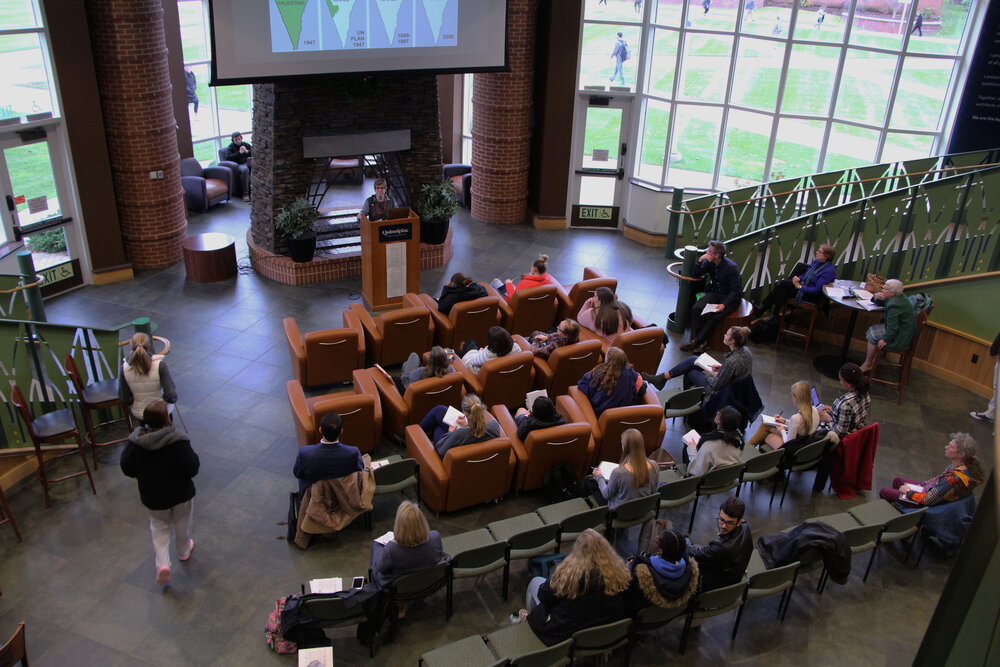
Students gather in the student center for the Teach-In on Indigeneity and Quinnipiac to listen to professor of philosophy, Anat Biletzki, speak about colonization in the Middle East. Photo by Hannah Tebo.

This lack of education about the land the university resides on and the name it holds has been a growing issue in the community which has led to new inclusivity programs like the Teach-In on Indigeneity to start taking place.

This Teach-In took place in the student center on Nov. 19 and addressed a wide range of issues. Professors from areas of history, philosophy and law lectured about indigeneity throughout history to educate those who attended about the history before settlers came and to show the detrimental impact of colonialism on the Native people. Around 77 students swiped in at the Teach-In according to Executive Director of the Albert Schweitzer Institute, Sean Duffy.

Of the multiple professors and lecturers that spoke, two indigenous students stood in front of peers and faculty to discuss what it was like to be an indigenous student at Quinnipiac. Tanta-Quidgeon was one of them.

Tanta-Quidgeon discussed her heritage and upbringing, but described one of the most difficult parts of being a indigenous student on campus was the lack of clubs and organizations that brought Native students together. She said that through these new initiatives at Quinnipiac University there’s more awareness and they are starting to create student-led groups for indigenous students.

“I do have a good number of friends at school however, I am always excited when I come across another student who is Native American,” senior psychology major and Mohegan tribe member, Kristina Jacobs said. “It is a really good feeling to have people who understand your culture and way of life and to share something with someone that is so close to your heart.”

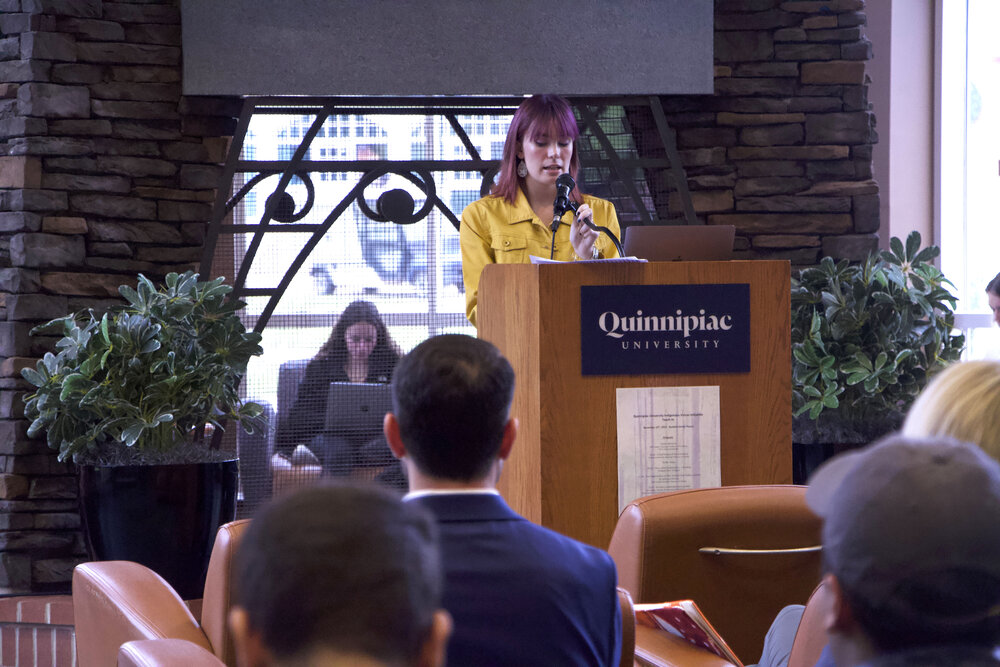
Tanta-Quidgeon speaking at the Teach-In to students and faculty about what it’s like to be an indigenous student at a predominantly white university. Photo by Hannah Tebo.

Lala Forrest, a first year medical student at Quinnipiac University, was the second indigenous student to stand in front of students and faculty to discuss the barriers of being a Native American student.

Originally from the Pit River tribe in California, Forrest spent the first year of her life on the reservation with her single mother. She moved off the reservation as a toddler because her mother wanted to provide her with opportunities and resources that weren’t available on the reservation.

For her, college was only ever an option, not something she had to do.

In high school, she found a program that helped first-generation Native American students apply to college. She spent four years at University of California San Diego before applying to medical school. She discussed at the Teach-In the low enrollment of Native students to medical schools and revealed that in 2018 out of 30,000 Native college students, four applied to medical school and zero got in.

 “This is a call for medical schools to increase their representation of Native Americans in medicine,” Forrest said. “And this is important because Native students want to go back and help their communities, they want to help people who are suffering disproportionately in nearly every health category.”

Forrest then discussed a “pipeline project” the University of Minnesota has for indigenous students to help them prepare for medical school. They start preparing these students in middle school and provide support for these students all the way until they get to medical school. She explained that Minnesota showed support of Native students with 13 percent of the faculty at the school being indigenous and having Native faculty members on the admissions committee.

She wrapped it all back around to being an indigenous student at Quinnipiac and the purpose of the new events being introduced to the community.

“Our purpose is to foster a campus-wide conversation on indigenous identities, histories and culture,” Forrest said. “The goal I think of this initiative is to work towards social justice, equity and inclusivity for indigenous people and how we need to be bearing an indigenous name and residing on indigenous lands be culturally responsiveness but also responsible with that.”

 The school is also working with an organization called the Akomawt Educational Initiative, a group that travels around east coast schools, connecting colleges with indigenous communities.

“These are the types of things we would like to change, the structure at the university,” Chris Newell, Passamaquoddy tribe member and one of the leaders of the Akomawt Educational Initiative said. “One that is welcoming to all people.”

Three members circulated through speaking at the podium. They talked about indigenous people today and how they are still fighting for rights. They discussed the Standing Rock protests, the importance of accepting different forms of knowledge as credible and what Quinnipiac can do to keep this type of inclusive conversation alive on campus.

They also visited campus on Dec. 2 and professors at the university were able to individually meet with the team to discuss how to create curricula that is more inclusive of Native histories, culture and knowledge.

“Being a native student at a predominately white school can be difficult, especially when some of our experiences are so different,” senior psychology major and Mohegan tribe member Lauren Jacobs said. “I think that Quinnipiac should advocate and try to change Columbus Day to Indigenous People’s Day and just create more awareness and more information regarding native culture. Further, I think that Quinnipiac should make it more known that Quinnipiac is named after a tribe.”

So why has the university waited until 2019 to start this type of conversation?

According to Duffy, past presidents prioritized establishing the university.

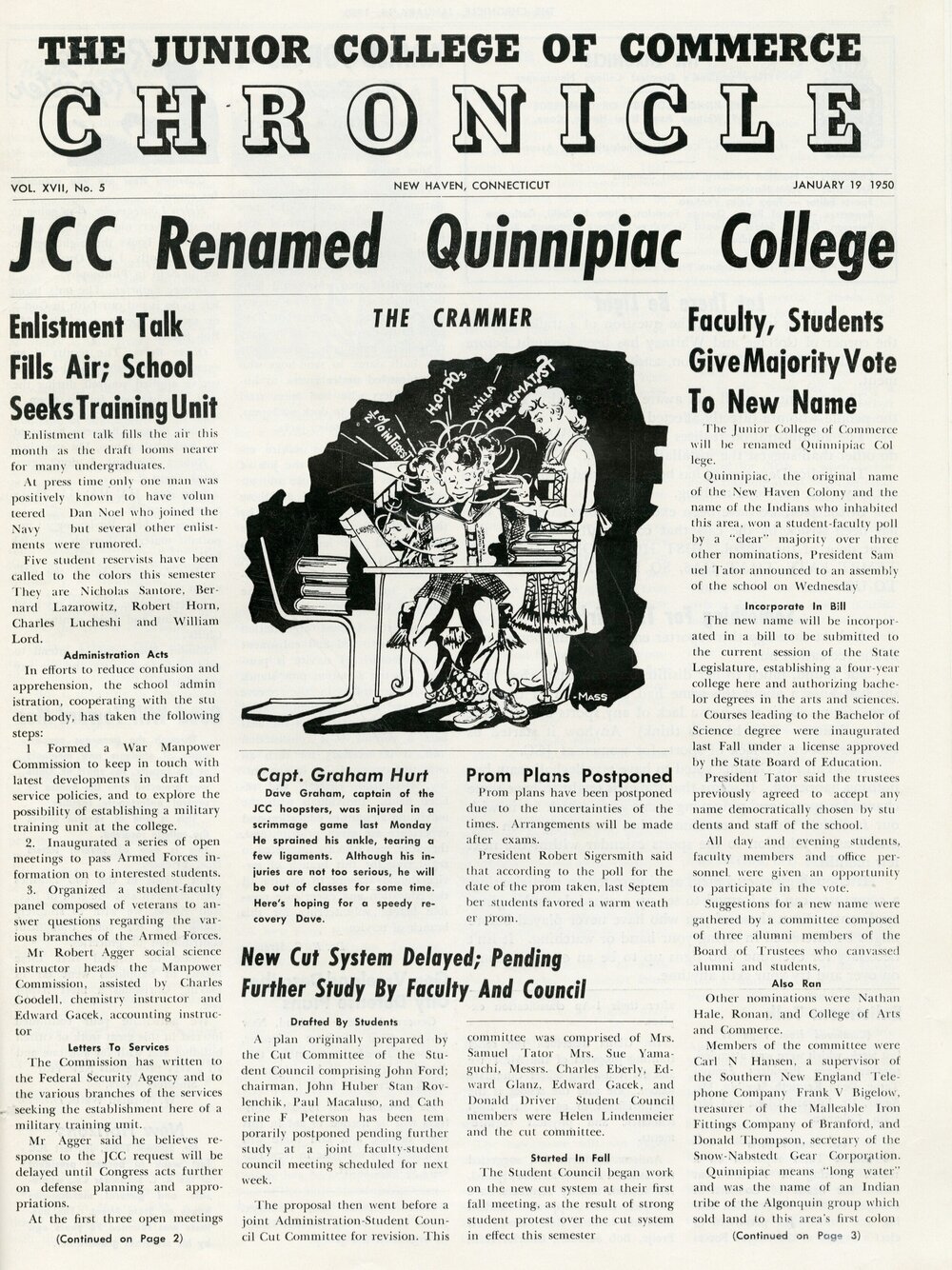
1950 Chronicle article reporting on the changing of JCC to “Quinnipiac College.” Courtsey of Bob Young, QU Libraries.

“There were bits and drabs [of events] over the years,” Duffy said. “The focus was really on bringing on what had been the Junior College of Commerce and limp through the ‘70s and ‘80s that way to its next level. Since then the student population has almost doubled in size and there had been a lot of programmatic growth and development that we were really focusing on as an institution.”

And the university has grown a lot since it first opened its doors in 1929.

Quinnipiac University was originally founded in 1929 under the name “The Connecticut College of Commerce” according to Duffy. At the time, the college only offered two year degrees but in 1950 the institution admitted the first four-year class.

Then in January of 1950, the college changed its name to “Quinnipiac College” after the students and faculty voted between four different names which were Nathan Hale, Ronan, Quinnipiac College and the College of Arts and Commerce, according to Duffy.

According to the 1951 Quinnipiac General Catalogue, the school’s comprehensive source of departamental, college and university-wide information, the school was originally named after the Quinnipiac plantations but according to Duffy the university was named after the Algonquin tribe that were named “Quinnipiac” which translates to “long water people.” When the tribe sold the land to white colonists, the settlers named the land Quinnipiac before changing it to New Haven according to honorary story teller for the Quinnipiac and adjunct professor at the university, Dorothy Howell.

But it is still unclear who the Quinnipiac were.

According to Howell, there isn’t much known about the tribe before white settlers came to the New Haven area. The tribe was small and in 1668 when settlers came to the land, the tribe sold the land to colonists who reserved a small piece for the Natives which is now looked at as one of the first Native American reservations in the United States according to Howell.

The tribe today is fragmented. According to Howell, many of the members have been adopted into the tribe just as she was. Howell believes current members have much to add to the university that could begin to establish new traditions just like Quinnipiac Weekend was once an integral part of the community.

In the early 1950s, the university celebrated its first ever ‘Quinnipiac Weekend’ during the first weekend of May. According to the General Catalogue, this was a celebration of the founding of the university.

“The weekend was originally meant to celebrate Quinnipiac’s heritage and give the students a few days to celebrate being part of this community,” Duffy said.

The university held a variety of events for students including shows, a picnic at Holiday Hill in Cheshire and a prom at night according to one 1967 issue of the Chronicle. However, there was no celebration or mention of the indigenous people and land the school is named after. The weekend was more focused on celebrating the founding of the university rather than the name.

The university officially stopped sponsoring Quinnipiac weekend festivities after a student was killed in 2007 walking across Whitney Avenue according to a 2016 Chronicle article.

 In that same year, the famous ‘Legend of the Bobcat’ was integrated into the community to connect the university’s mascot, name and students to the school and keep the sense of community alive. But it’s a story created by students at the school rather than a legend from the Quinnipiac tribe.

“For one thing, we really ought to replace the bogus legends with stories from the actual Quinnipiac history we can discover,” Howell said.

According to Newell there is a legend behind the Sleeping Giant that is told by the tribe and the community should adopt that version instead.

“Indigenizing Quinnipiac means tying it to the land,” he said. “Maybe not tying it to a student-created legend because with what we’ve seen with legends that were created and the way the internet is, they become fact to some people.”

In 2001, the university decided to change the mascot of the school from the Braves to the Bobcats. After a recommendation by former university president, John Lahey, the institution abandoned the usage of a stereotypical Native American chief and transitioned to a more culturally appropriate mascot.

 The university still has work to do according to Howell, but she thinks these new programs are a good start.

“In brief, the one thing we owe the land we occupy, whether in honor of the Quinnipiacs or as an obligation we should all be accepting, is respect,” Howell said. “How we express that respect will be up to the QU community.  The decisions are beyond you and me, but one day of lectures, one month dedicated to Native Americans, one pow-wow, one year of indigenous programs are no more than a start.”